
18+ Independent guide: we are not an operator and not Spribe. This page has affiliate links. Read the full disclosure
Aviator Strategy and Tricks: Budget, Cash-Out Targets and What They Cannot Change
A strategy cannot promise a result, but a plan can keep a loss inside the limit you set. This page shows the arithmetic and the common tricks, with no invented win rates.
By Rahul Ramsi · published 16/11/2026 · data checked 16/11/2026 · page updated 17/11/2026
- No invented results
- Arithmetic only
- Checked 16/11/2026
- Independent guide
Game artwork: the Aviator plane in flat vector style.
What to remember
- RTP is 97%, a long-run average stated by Spribe.
- We ran no test, so we publish no win rates.
- Budget, stake and stop rules manage risk, they do not remove it.
- Practise in the free demo before anything else.
Short answer: is there an Aviator strategy that works?
We found no verified one, and we tested none.
Spribe states an RTP of 97% and, on the pages we read, no way to beat the game. Many players hope for a trick, but a strategy here means a plan: a budget, a bet size (the stake), a cash-out target and a point at which you stop. Such a plan can cap how much you lose in a session. It cannot change the long-run average, and we have no test data that says otherwise.
What the stated RTP means in arithmetic
A worked example in units, not money. It is arithmetic from Spribe's figure, not a test result.
Illustration: arithmetic in units.
| Item | Value |
|---|---|
| Stake per round (units, not money) | 10 |
| Rounds | 100 |
| Total staked | 1,000 |
| RTP stated by Spribe | 97% |
| Long-run average returned | 970 |
| Long-run average shortfall | 30 |
Units are not money. The average is a long-run figure over a very large number of rounds: one session of 100 rounds can end far above or far below it. Source of the RTP: Spribe's game page, checked 16/11/2026.
A budget plan in five steps
General money-management guidance, not from Spribe, and not a way to beat the game.
Illustration: a budget cut into equal parts.
- 1
Fix a budget first
Decide the most you can lose before the first round, in money you can do without. When it is gone, the session is over.
- 2
Size the stake to the budget
Divide the budget by the stake to see how many rounds it covers. A stake of 1 unit on a budget of 100 units is 100 rounds of runway, and 10 units is only 10.
- 3
Set a stop-loss and a stop-win
Name both numbers in advance. Walking away at either is the strategy, and the numbers are yours to choose, not ours.
- 4
Set a time limit
Time passes quickly in a fast game. A time limit stops a session that has gone on longer than you meant.
- 5
Never chase a loss
Raising the stake to win a loss back is how a small loss becomes a large one. If you notice the urge, stop.
If it stops being fun, see responsible gambling for a national helpline and for signs that it is time to stop.
Cash-out targets: low, middle and high
Three styles. The trade-off between them is logic, not a measured result.
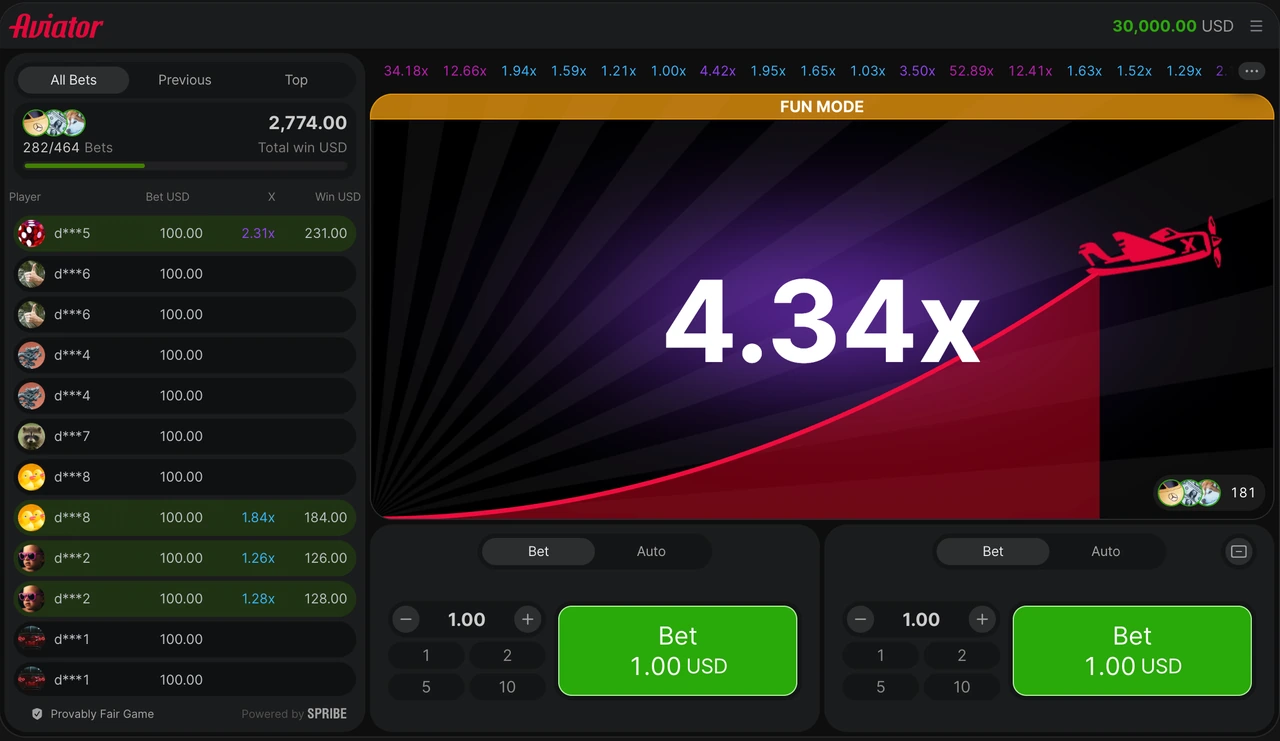
Screenshot of the free demo, 17/11/2026: one round at 4.34x, with the bets list showing cash-outs from 1.26x to 2.31x. The game runs in Spribe's interface on virtual credits.
| Style | What you do | What it trades off |
|---|---|---|
| Low target | Cash out at a small multiplier, often, while the plane is still climbing | A low multiplier is reached at least as often as a higher one, so more rounds end in a small gain. Each gain is small, and one crash costs the full stake. |
| Middle target | Cash out at a moderate multiplier | A middle ground. It is hit less often than a low target and more often than a high one. |
| High target | Wait for a large multiplier, rarely cash out early | A high multiplier is reached no more often than a lower one, so most rounds end in a loss of the stake. A rare hit pays more. |
The multiplier starts at 1 and grows, so reaching a higher value is never more likely than reaching a lower one. Players who aim at higher multipliers accept that more rounds end with the stake lost. We have not measured how often any target is reached and publish no figure.
Try a cash-out target in the demo
A target is only a number until you watch how rounds end. The demo uses virtual credits, so what you see there says nothing about real results.
Free demo · no real money
-
97%
RTP per Spribe
-
Crash
Game type
-
Multiplayer
Mode
Demo mode on virtual credits, provided by SlotsLaunch. No deposit is needed or asked for here. The demo supplier sets the interface language and the currency of the virtual credits, so the screen may differ from what you expect.
Common Aviator tricks, checked against what we can verify
The tricks behind the searches for kaise khele trick. We tested none of them.
| Trick | The claim | What we can say |
|---|---|---|
| Double the stake after every loss | A win will come and cover everything | It makes stakes grow fast (table above) and needs a budget that a long losing run can exceed. It does not change the stated RTP. We tested none. |
| Wait for a run of low rounds, then bet | The next round is "due" a high one | The Spribe pages we read describe no way to use past rounds, and we found no source that does. We do not recommend it. |
| Two bets with different targets | One bet covers the other | It splits the stake over two targets. We found no source that says it changes the result, and we ran no test. |
| Auto cash-out at a fixed multiplier | Removes the timing mistake | It fixes the target in advance, which helps you keep to a plan. It is a convenience, not an edge. |
| Play at a "lucky" time of day | Some hours pay more | The Spribe pages we read mention no time-of-day effect, and we found no source that does. What you control is how long a session lasts. |
What doubling after a loss does to the stake
The arithmetic behind the best-known trick, starting from a stake of 1 unit.
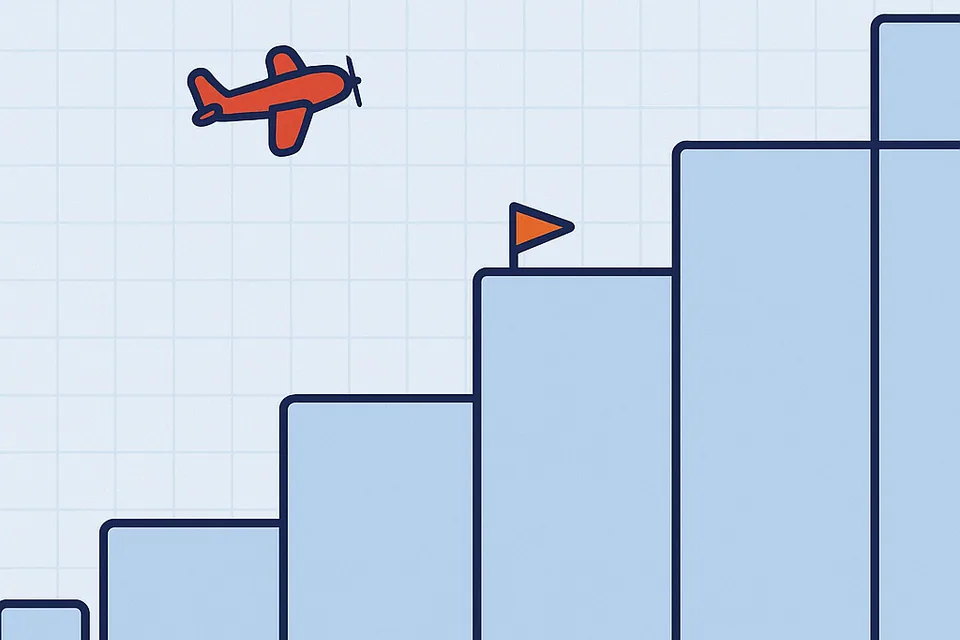
Illustration: doubling gets large fast.
| After | Result |
|---|---|
| Loss number 1 | Lost so far: 1 units; next stake: 2 units |
| Loss number 2 | Lost so far: 3 units; next stake: 4 units |
| Loss number 3 | Lost so far: 7 units; next stake: 8 units |
| Loss number 4 | Lost so far: 15 units; next stake: 16 units |
| Loss number 5 | Lost so far: 31 units; next stake: 32 units |
| Loss number 6 | Lost so far: 63 units; next stake: 64 units |
| Loss number 7 | Lost so far: 127 units; next stake: 128 units |
| Loss number 8 | Lost so far: 255 units; next stake: 256 units |
Arithmetic only. Real play adds the budget limit: a series like this can pass any budget you set.
Is there a best time to play?
A common question, with a short honest answer.
The Spribe pages we read mention no time of day that changes the game, and we found no source that does. Claims of lucky hours are unverified here. The time that matters is the length of your session, so set a time limit before you start (step 4 above).
What we did not test
So that this page is not read as more than it is.
No test log
We ran no series of rounds and keep no log, so there are no win rates, no best multiplier and no results here.
No audit of the game
We cannot audit random number generation. We state Spribe's RTP and nothing beyond it.
No review of sellers
We checked no course, group or tool. For how to check a claim, see our predictor page.
No bet limits quoted
We could not confirm bet limits from Spribe's pages, so we quote none.
How a claim of a sure method should be checked is on our predictor page. The rules of a round are on how to play Aviator.
Read next
Aviator predictor and hacks
What these tools claim and what proof would count.
How to play Aviator
A round in plain words, and what we could not confirm.
Responsible gambling
Limits, signs to stop and a national helpline.
Is Aviator legal in India?
The Online Gaming Act, 2025, article by article.
Original or fake Aviator
Who makes the game and how to tell it from clones.
Aviator strategy and tricks: frequently asked questions
Is there a trick to win in Aviator (Aviator game kaise khele trick)?
We found no verified trick and tested none. The Spribe pages we read describe no way to beat the game. What you can control is the budget, the stake, the cash-out target and when to stop, and those manage risk, they do not remove it.
What is the best Aviator strategy?
We do not name a best one. A strategy cannot change the RTP Spribe states, and we found no source that says a cash-out rule does. A plan with a fixed budget, a stop-loss and a time limit keeps a loss within what you chose in advance.
What is the best time to play Aviator?
The Spribe pages we read mention no best time, and we found no source for one. Treat claims of lucky hours as unverified. The time that matters is how long you play, so set a limit before you start.
Does doubling the stake after a loss work (martingale)?
It raises the stake after every loss: 1, 2, 4, 8 units and so on, so after eight losses in a row 255 units are lost and the next stake is 256. That is arithmetic. It does not change the stated RTP, and a long losing run can pass any budget. We have not tested it.
What cash-out multiplier is safe?
None is safe. A lower target is reached more often than a higher one, but one crash before it costs the whole stake. We give no multiplier as a recommendation, because we have no test data.
How much should I stake per round?
That is your decision, based on a budget you can afford to lose. Divide the budget by the stake to see how many rounds it covers. A smaller stake gives more rounds, not better odds.
Can I practise a strategy in the free demo?
Yes. The demo runs on virtual credits, so you can try targets and the controls without money. Demo results do not predict real play, so use it to learn the pace, not to judge a method.
Does a strategy change the RTP of 97%?
Spribe states one RTP figure for the game and, on the pages we read, no separate figures per strategy. We found no source that a cash-out rule changes it, and we tested none. RTP is a long-run average, not a promise for one session.
Is Aviator a game of skill, so can a strategy beat it?
The timing of your cash-out is your decision, but this page does not claim that skill changes the long-run result. For the law, the Online Gaming Act, 2025 defines an online money game "irrespective of whether such game is based on skill, chance, or both" (Art. 2(1)(g)), so the label does not settle the legal question.
Do Aviator tips from other players work?
A tip from another player is one person's experience, often shown with selected wins. We tested none and link to none. Treat a tip as unverified until it comes with a full, dated record, and see the predictor page for five checks to run on a claim.
Can I earn money from Aviator?
We found no source that shows steady earnings and publish no win figures. Gambling involves risk of loss and is not a source of income. The demo pays nothing, because its credits are virtual.
Do YouTube or Telegram strategies work?
We have tested none and do not link to any. A strategy shown only with selected wins is a selection, not a record. See the predictor page for five checks to run on a claim.
Should I pay for a strategy, course or signal group?
We would not, on the evidence we have: we found no verified result for any paid method and tested none. Ask for a full, dated record before you pay anything.
Is it legal to play Aviator for money in India?
This page gives no verdict. The Online Gaming Act, 2025 bans online money games, and our legal page quotes the text article by article with the date we read it. It is not legal advice.
Sources we read
- Spribe: Aviator game page · checked 16/11/2026 · description of the game and the stated RTP
- SlotsLaunch: Aviator catalog entry · checked 16/11/2026 · demo provider
Try the controls before you plan anything
The demo runs on virtual credits, so you can try targets and the pace of a round with no money at stake.
18+. Gambling involves risk of loss. Tele MANAS, the national mental health helpline: 14416 or 1-800 891 4416 (Ministry of Health, checked 16/11/2026). Responsible gambling

Who writes this guide
Rahul Ramsi writes the guides on this site. Author pages under this name exist on Business News Week and on ThisGenGaming. We publish only what we could confirm: every number on the page comes from a document listed in the sources, with the date we read it (16/11/2026). More about the author
How we check facts · Responsible gambling · Affiliate disclosure · About the site